
Cultivating interests and some of my favorite books from undergrad
At the close of the spring semester, I spent a bit of time advising students on the near-term: which classes to choose for the fall, how to prepare for graduate school, ideas for things to do over the summer, etc. During these discussions, I like to ask students about their interests. Most of the time, they don’t know. If they have an answer, it’s often something trendy, e.g., NLP or AI. Either case is fine; I didn’t really have an answer initially when I was in their shoes.
Occasionally, a student will name a course they’ve enjoyed. Here are some of my stock responses. Was it that the professor was interesting? Or the problems seemed cool? That it just clicked? That it tied things together from other classes? Most importantly: have you followed up on it?

Cultivating interests is an often neglected part of the undergraduate experience. Perhaps, this is because it seems like something that should occur naturally and passively as one goes through their coursework. Often, building an interest starts in the classroom but continues as students explore new ideas, face new problems, and build new things. Actively cultivating one’s interests is a skill that’s developed over time and is often a pathway to attaining mastery.
For me, cultivating interests came through reading and engaging with books. I was fortunate to have several professors willing (and often excited) to recommend books and papers and who took the time to chat about random stuff I came across in the library. I try to pay this forward with my students by always having recommendations handy. Here are some of my favorite books from undergrad that helped me first cultivate my interests. I bring these up a lot but have never written about them in detail. I hope this serves as a useful resource for students looking to build their interests.
background
In undergrad, I essentially completed a build-your-own degree in philosophy, politics, and economics. PPE as an interdisciplinary major was not as prevalent as it is today. The bulk of my coursework was in economics and philosophy but shifted toward logic, mathematics, and statistics at the end. I quickly learned that I didn’t have the tools to rigorously tackle the sort of questions I wanted to answer.
The books below are grouped roughly into three categories: histories of philosophy and economics, PPE and political philosophy, and analytic philosophy.
histories of philosophy and economics
The first year courses in philosophy and economics really clicked for me. It was 2009 at the tail end of the financial crisis and interesting questions about the financial system, macroeconomic models, and the foundations of economics were in the air. While I enjoyed building economic intuition in my principles and intermediate courses, it was unsatisfying that the ideas and models were presented in a vacuum, more-or-less as laws of nature. This approach seems reasonable for comparative advantage and (probably) diminishing marginal utility but is much less clear for something like the steady state in the Solow growth model.
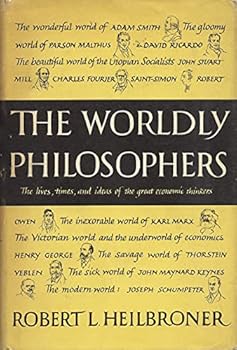
Robert Heilbroner’s The Worldly Philosophers (1953) is a lively history of political economy built around the big names and was exactly the sort of book I was looking for (or so I thought). Much of it was surprising! I had no idea how much of the introductory material could be found in Adam Smith and David Ricardo. Or that marginalism was such a big deal in economic theory in the late nineteenth century. Or that Keynes was such an odd character yet such a wide-ranging thinker. While exciting, this book felt far removed from the economics I saw in my courses. It is mired in mid-twentieth century debates about the merits of capitalism and socialism, which can be misleading to an impressionable reader today. Still, it provided a useful historical perspective and made me excited for later courses.
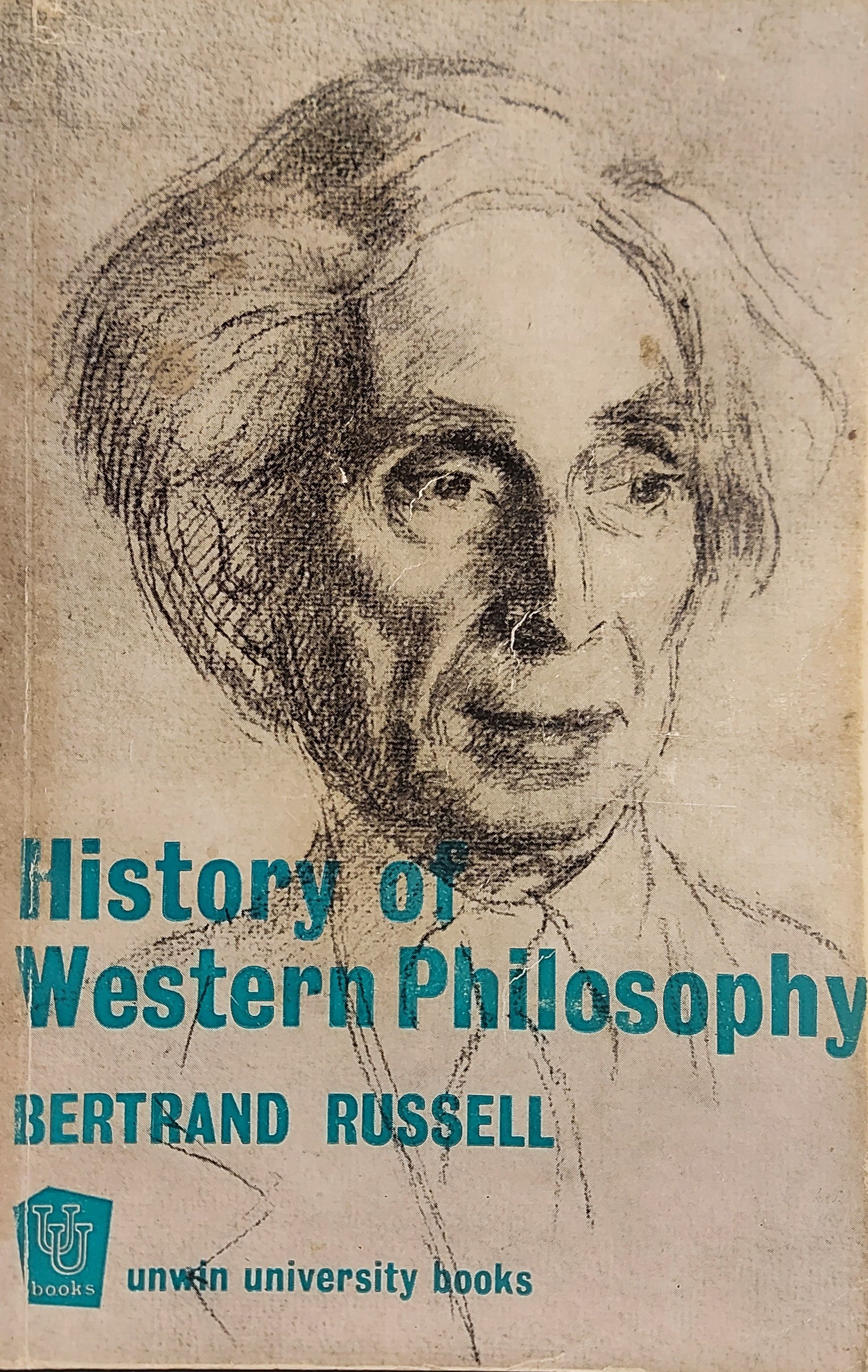
After reading Bertrand Russell’s The Problems of Philosophy in an intro course, I stumbled across his voluminous History of Western Philosophy (1945) in a used book store and became engrossed in it like no other. This book is a sweeping history of Western philosophy from the pre-Socratics to the early twentieth century. Russell’s writing is witty and warm, transforming what could have been an episodic slog into a compelling narrative. This book deservedly receives a lot of criticism for various inaccuracies and biases. I’ve heard it disparagingly called “the History of Western Philosophy according to Bertrand Russell”. Despite these issues, I recommend it as an engaging (if limited) perspective on philosophy and the broader history of ideas.
ppe and political philosophy
I became drawn to the interplay between philosophy and economics, particularly in the direction of using tools from economics and decision theory to approach philosophical questions. In an ethics course, I read two books that would take me down the social contract theory rabbit hole and change how I thought politically: A Theory of Justice by John Rawls (1971) and Morals by Agreement by David Gauthier (1986).
In A Theory of Justice, Rawls develops a theory of distributive justice within the framework of social contract theory. He introduces the concepts of the original position and the veil of ignorance, which is a thought experiment designed to determine which principles of justice rational individuals would choose if they were ignorant of their own social status, abilities, and preferences. Under the hood, Rawls’ approach relies quite a bit on microeconomic theory, particularly decision under uncertainty, to make sense of what happens in the original position (in its original formulation, at least). I found Rawls’ approach compelling in broad strokes, even if the technical bits are justly subject to criticism.
In Morals by Agreement, Gauthier develops a social contract theory of morality using ideas from game theory. He argues that morality emerges as a rational social solution to the problem of cooperation in a world of self-interested agents. By casting social interactions as instances of the prisoner’s dilemma, Gauthier shows how social norms can arise to facilitate cooperation and mutual benefit. While thought-provoking, Gauthier’s approach has a bunch of serious issues. I even wrote a little-read paper on these issues, published in a special journal issue reflecting on Gauthier’s work. This grew out of a term paper that was helped along with comments and moral support from several of my professors.
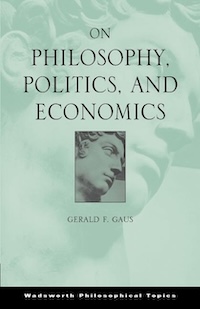
While thinking about Rawls, Gauthier, and other social contract friends, I came across On Philosophy, Politics, and Economics (2008) by Jerry Gaus (in a sneaky “formal social science” section of the library), which gently introduces the tools of individual and collective choice theory in the context of PPE. This book opened my eyes to the breadth of modern theoretical tools available for thinking about decision making as well as revealing the stark deficiencies in my math background. This also introduced me to Jerry Gaus’ work thinking about how societies can converge on shared values and norms despite deep moral disagreement, which I’ve followed ever since.
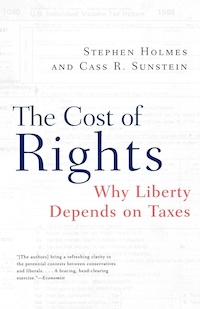
From a different direction, Cass Sunstein and Stephen Holmes’ The Cost of Rights (1999) brings wholly practical economic considerations to bear on political philosophy. This book challenges the sharp distinction between positive and negative rights by arguing that both require enforcement to be genuine rights. In this sense, public finance and taxation are key to preserving rights, contrary to popular arguments at the time. As an empirical matter, rights are not absolute and are only as strong as the institutions that enforce them. I read this book as part of an economics and ethics seminar and came away appreciating public policy much more. After undergrad, I spent a year working in public policy analysis, and I like to think this book had something to do with it.
analytic philosophy
When approaching philosophy, I’ve always been drawn toward epistemology, broadly construed, and hesitant toward metaphysics. Perhaps, reasoning about knowledge and belief is better grounded in my other interests while metaphysics seems abstract and spooky. I also had some exposure to Hegel and idealism early on and am still recovering!
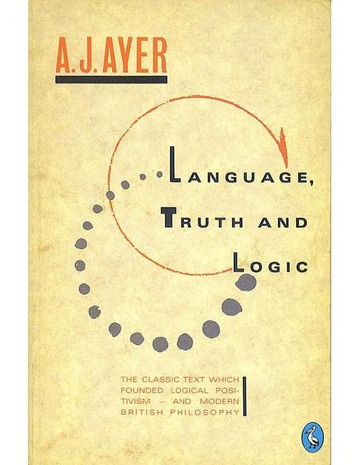
This outlook was reinforced when I read A. J. Ayer’s Language, Truth and Logic (1936) in an early analytic philosophy seminar. This book discusses the verification principle, which holds that meaningful statements are either empirically verifiable or analytically true. Ayer wrote this book after spending some time with the Vienna Circle, a group of philosophers, scientists, and logicians in interwar Vienna who sought to make philosophy rigorous and scientific. Wielding the verification principle, Ayer slices through metaphysics, ethics, and theology, arguing that many traditional philosophical questions are actually meaningless or nonsense, since they make no difference empirically. This book is bursting with excitement and energy. Ayer wrote this book in his early twenties and his youthful enthusiasm clearly shows. I too became swept up in the excitement while reading, even though I knew this project runs into serious methodological difficulties.
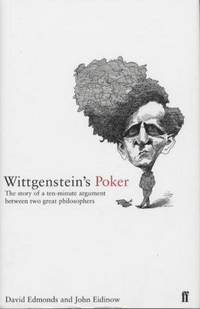
The verification principle was developed by the enigmatic philosopher Ludwig Wittgenstein. David Edmonds and John Eidinow’s Wittgenstein’s Poker (2001) is an account of analytic philosophy during the first half of the twentieth century based around a famous incident between Wittgenstein and Karl Popper during a 1946 lecture at Cambridge over the existence of genuine philosophical problems. Unlike most other books in this post, this book is meant for a wide audience. The writing is excellent, characters are larger than life, and the ideas are juicy enough to have some heft but still comprehensible enough. This book was recommended to me a few times as a fun look at these characters and how they thought about their work. Not all reading should be from serious tomes!
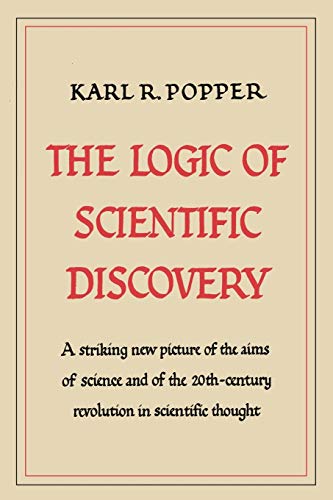
Wittgenstein’s foe at the Cambridge lecture, Karl Popper, is the author of The Logic of Scientific Discovery (1934), which I read excerpts from for a philosophy of science course. Popper argues that the hallmark of scientific theories is falsifiability: a theory is scientific if it can be tested and potentially refuted by empirical evidence. This view emphasizes the provisional nature of scientific knowledge, since no theory can ever be definitively proven, and offers an alternative to confirmation theory. Falsification was eagerly embraced by actual, working scientists who felt his description of “conjecture and refutation” perfectly matched what they actually did in the laboratory. My undergraduate thesis challenged Popper’s understanding of probability. I spent several months in 2013 deep in this book!
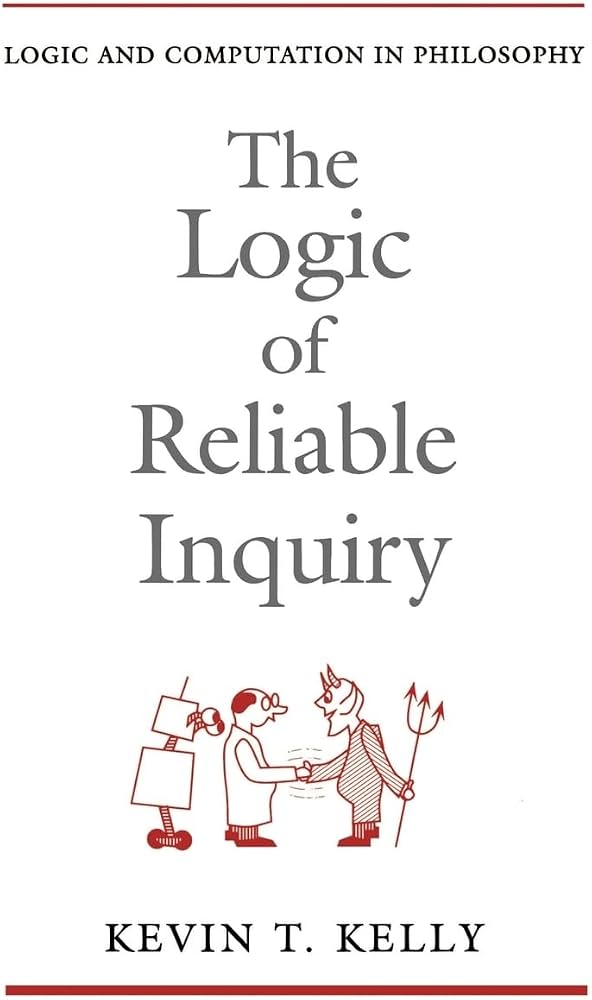
My increasing interest in formal methods sent me wandering into the logic section of the library, where I stumbled across Kevin Kelly’s The Logic of Reliable Inquiry (1996). It was the first book I encountered that truly brought out-of-the-box mathematical ideas to bear on the philosophical problems I cared about. Kelly frames issues in the philosophy of science and induction as problems of formal learning theory, where ideas such as verifiability and falsifiability are expressed in the language of topology. Motivated by this work, I spent my last year of undergrad diving into topology and analysis. In particular, I spent a lot of time working through James Munkres’ Topology (1974), which is a solid mathematical text (well, the first half is, at least) containing the occasional pithy remark or snarky comment. Before heading off to grad school to study math and logic, I took a course with Kelly during a logic summer school at Carnegie Mellon.
concluding thoughts
Working through these books and chatting about them with professors and friends was a formative experience. Of my interests that developed out of this, some were short-lived. Others grew into a paper or thesis (misguided or otherwise). Still others I continue to follow or work on in some form to this day.
For those with a research or academic career in mind, cultivating interests is useful for finding research areas, developing expertise, and building a research agenda. However, the value of having interests extends beyond academia. While working in industry, I often found myself steering projects in directions that I found interesting, which gave me an excuse to learn new things while employing ideas and techniques I already had a handle on.
For students feeling aimless in their studies, look for something interesting you’ve seen in your courses and follow up on it. Ask your professors for recommendations. Go to the library and browse the shelves. See where it takes you. You may find a dead end. You may find something that clicks and opens up a new world of ideas.
 Buy me a coffee